

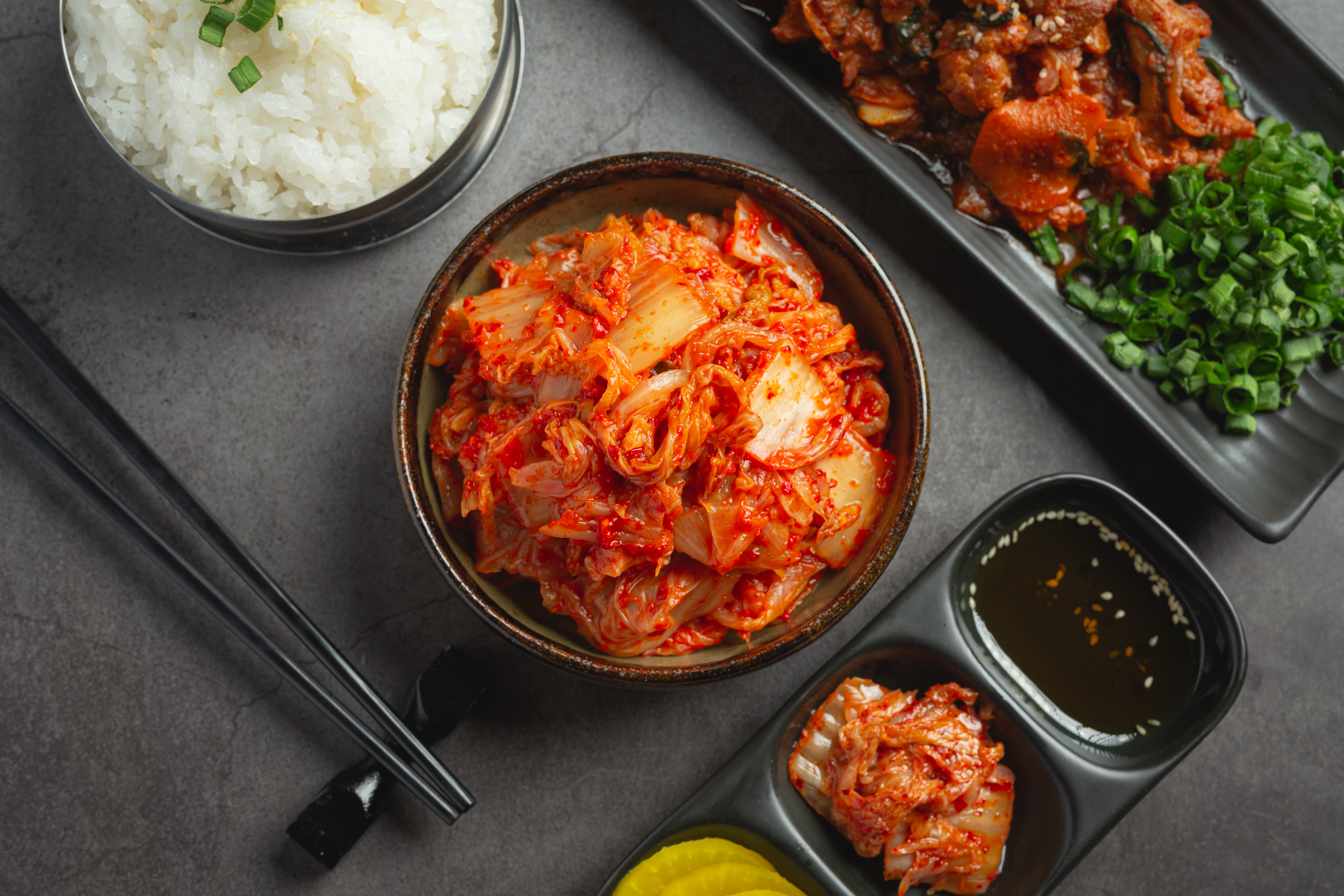
Written by Tou Calo Nutrition Team · Vulcan Labs · Updated August 2026. Nutrition data sourced from USDA FoodData Central (FDC ID: 170392).
Kimchi contains 15 calories per 100g — making it one of the lowest-calorie fermented foods available and an excellent high-volume, low-calorie addition to any meal. A standard ½ cup serving (75g) contains just 11 calories. Despite the minimal calorie count, there is one nutritional variable worth monitoring: kimchi contains 498mg of sodium per 100g — approximately 22% of the daily recommended limit per serving. This guide covers the full nutrition facts, calories by serving size, how different kimchi varieties compare, and why the sodium number matters in practice.
Quick answer — kimchi calories:
Per 100g: 15 kcal · Per ½ cup (75g): ~11 kcal · Per 1 cup (150g): ~23 kcal
Macros per 100g: 1.1g protein · 2.4g carbs · 0.5g fat · 1.6g fibre · 498mg sodium
Use our TDEE calculator to find your daily calorie budget.

In this guide
- Kimchi nutrition facts — full breakdown
- Calories by serving size
- Calories by kimchi variety
- The sodium note — what to know
- Is kimchi good for weight loss?
- FAQ
Kimchi nutrition facts — full breakdown
All values per 100g raw cabbage kimchi (baechu-kimchi). Source: USDA FoodData Central (FDC ID: 170392).
| Nutrient | Per 100g | Per ½ cup (75g) |
|---|---|---|
| Calories | 15 kcal | 11 kcal |
| Protein | 1.1g | 0.8g |
| Carbohydrates | 2.4g | 1.8g |
| Dietary fibre | 1.6g | 1.2g |
| Fat | 0.5g | 0.4g |
| Sugars | 0g | 0g |
| Sodium | 498mg | 374mg |
| Vitamin K | 44mcg (36% DV) | 33mcg |
| Folate | 52mcg (13% DV) | 39mcg |
| Iron | 2.5mg (14% DV) | 1.9mg |
Calories by serving size
| Serving | Weight | Calories | Sodium |
|---|---|---|---|
| 1 tablespoon | 15g | 2 | 75mg |
| ½ cup (typical side dish) | 75g | 11 | 374mg |
| 100g | 100g | 15 | 498mg |
| 1 cup | 150g | 23 | 747mg |
| Large bowl (200g) | 200g | 30 | 996mg |
Kimchi is so low in calories that even a large serving barely registers in a daily calorie budget. The variable worth tracking is sodium — a full cup (150g) provides 747mg of sodium, approximately one-third of the AHA’s recommended daily limit of 2,300mg. Use our BMR calculator to find your daily calorie baseline.

Track meals in 3 seconds — just snap.
AI reads your plate and logs every calorie and macro instantly. Free on iOS.
Calories by kimchi variety
With over 200 regional varieties across Korea, kimchi ranges from fiery red baechu to mild white baek-kimchi. Calorie counts vary slightly by variety:
| Variety | Calories/100g | Notes |
|---|---|---|
| Baechu-kimchi (napa cabbage) | 15 | Standard variety — most widely available |
| Kkakdugi (radish cubes) | ~20 | Slightly higher from added sugar in recipe |
| Oi-sobagi (cucumber) | ~12 | Lower — cucumber base, shorter fermentation |
| Baek-kimchi (white, no chilli) | ~13 | Milder, slightly lower sodium |
| Store-bought brands (e.g. Chongga) | 25–35 | Often higher due to added sugar and seasoning |
Store-bought kimchi tends to be higher in calories than homemade because manufacturers often add sugar to balance acidity and speed up flavour development. Always check the nutrition label on packaged kimchi — values can range from 15 to 35+ kcal per 100g.
The sodium note — what to know
Kimchi’s only significant nutritional consideration is sodium. Kimchi contains 498mg of sodium per 100g — equivalent to about 22% of the AHA daily limit in a single 100g serving. For most healthy adults this is not a concern in typical serving sizes, but it is worth noting for people monitoring blood pressure or following a low-sodium diet.
The sodium in kimchi comes primarily from the salt used during the lacto-fermentation process, which draws water from the cabbage and creates the brine that preserves the kimchi. This is the same sodium that helps create the beneficial probiotic environment — so low-sodium kimchi exists but ferments differently and has a distinct texture and flavour profile.
If you eat kimchi as a condiment (1–2 tablespoons per meal), sodium from kimchi is minimal — approximately 75–150mg per tablespoon. If you eat it as a main side dish in Korean meal portions (150–200g), sodium contribution is more significant.
Is kimchi good for weight loss?
Yes — kimchi is one of the most weight-loss-compatible foods available. At 15 calories per 100g with 1.6g fibre, it adds significant volume and flavour to meals with virtually no calorie impact. A 150g serving alongside rice and protein adds only 23 calories to the meal while contributing flavour, fibre and fermented food variety.
The practical benefit for weight loss is that kimchi increases meal satisfaction without meaningfully increasing calorie density. Adding 100g of kimchi to a rice bowl adds 15 calories but substantially changes the eating experience through its strong flavour and crunchy texture — making the overall meal more satisfying at the same calorie total. Use our calorie deficit calculator to set your daily target and plan meals around it.
Calories in kimchi — FAQ
How many calories are in kimchi?
Kimchi contains 15 calories per 100g, with 1.1g protein, 2.4g carbs and 0.5g fat. A standard ½ cup serving (75g) contains approximately 11 calories. A full cup (150g) contains approximately 23 calories. Store-bought brands may be slightly higher at 25–35 kcal per 100g due to added sugar. Always check the label on packaged kimchi for the specific product’s calorie count.
Is kimchi low calorie?
Yes — kimchi is exceptionally low in calories at 15 kcal per 100g. For comparison, this is similar to cucumber (16 kcal/100g) and lower than most other fermented or preserved foods. You can eat a 200g bowl of kimchi for approximately 30 calories — less than a single cracker. The only nutritional variable to monitor with kimchi is sodium, which is relatively high at 498mg per 100g.
How many calories are in a cup of kimchi?
One cup of kimchi (approximately 150g) contains approximately 23 calories, 1.7g protein, 3.6g carbs, 0.8g fat, 2.4g fibre and 747mg sodium. This makes a full cup of kimchi nutritionally negligible in calorie terms — it is essentially a free addition to any meal in calorie terms while contributing fibre, vitamins K and folate, and iron.
Does kimchi have a lot of sodium?
Relative to its calorie count, yes — kimchi is high in sodium. At 498mg per 100g, a typical side dish serving (75g) contributes approximately 374mg of sodium. This is not concerning for most healthy adults eating kimchi in normal quantities as a condiment or side dish. For people on a medically prescribed low-sodium diet, portion size is worth monitoring — a tablespoon (15g) contains only about 75mg of sodium and still provides the full flavour and probiotic benefit.
Is kimchi good for weight loss?
Yes. At 15 calories per 100g, kimchi is one of the most calorie-efficient ways to add flavour, fibre and volume to meals. It increases meal satisfaction without meaningful calorie contribution. A 100g serving adds only 15 calories while providing 1.6g fibre, 36% of the daily vitamin K requirement and a substantial probiotic content from the fermentation process. Use our BMR calculator to understand your daily calorie needs and build your meals around foods like kimchi that maximise volume and nutrition per calorie.
Disclaimer: Nutrition values are sourced from USDA FoodData Central (FDC ID: 170392) for standard cabbage kimchi. Values for store-bought brands, homemade recipes and different kimchi varieties will differ. Always check the nutrition label on packaged kimchi for accurate figures.
Written by Tou Calo Nutrition Team — Vulcan Labs
The team behind Tou Calo AI Calorie Counter.
Related tools:
BMR Calculator — your resting calorie baseline
TDEE Calculator — your total daily calorie burn
Calorie Deficit Calculator — your fat loss target

calories and macros in 3 seconds.